1/4: AI Is Accelerating Cybersecurity. But Who Is Moving Faster? Attackers or Defenders?
AI helps both attackers and defenders. PHP2Shell, intrusion reports, and benchmarks show why the time from discovery to verified containment matters.

You open your laptop, ready to fix one small bug before lunch. Three security alerts have other plans. Update PHP. Check yesterday’s package. Rotate those cloud credentials. Your tests are green. Your afternoon has changed.
Then someone asks in the team chat: “Is this because of AI?”
Sometimes AI helped uncover the problem. Sometimes it helped the attacker. Sometimes the victim sells AI tools and the documented failure is an exposed credential. Those explanations demand different responses.
My argument is that faster discovery and faster attack preparation make the time between finding an exposure and closing it more consequential. Public reports show the mechanisms. They do not establish a worldwide winner. To understand the race, we need to follow what happened between the useful finding and the consequential action.
Where AI fits into the story
When I read a security story, I try to work out which job AI was doing:
- AI as investigator: a researcher uses models to find, understand, or reproduce a weakness.
- AI as attacker assistance: an operator uses models for reconnaissance, tooling, analysis, or parts of an intrusion.
- AI tools as an exposed capability: malicious code attempts to invoke an agent already installed in a trusted environment.
- AI infrastructure as the target: attackers pursue platforms, credentials, or distribution channels supporting AI applications.
- No demonstrated AI involvement: a serious incident happens during the AI era, but its explanation does not require AI.
These categories can overlap. They are questions about mechanism, not labels that prove causation. An attack against an AI company does not establish that the attacker used AI. An AI-discovered bug does not establish that AI wrote the vulnerable code.
PHP2Shell: how AI helped uncover old vulnerabilities
Wiz’s 21 October research describes frontier models helping researchers turn longstanding PHP memory-safety weaknesses into working exploits. The team reports adapting exploits across applications in hours. That is evidence of AI-assisted research in this investigation; it is not a controlled estimate of how much faster all researchers or attackers have become.
The original PHP2Shell pair is CVE-2026-109618, involving out-of-memory corruption, and CVE-2026-109619, involving stale global state across requests. The weaknesses sit in the runtime beneath applications, the part of the stack your beautifully reviewed pull request does not fix. Researchers demonstrated remote code execution on representative deployments and also demonstrated process-memory disclosure. See the researchers’ technical summary and PHP’s advisory for CVE-2026-109619.
Use the published severity, not the early rumor: PHP’s OOM advisory gives a critical CVSS v4.0 score of 9.2. It also explains that exploit reliability depends on the build, extensions, frontend behavior, and memory layout. A critical rating warrants urgent remediation; it does not mean every deployment is equally easy to compromise.
Similarly, PHP’s large share of website technology is not a count of exploitable or compromised websites. A claim that “70% of the internet was hacked” would confuse technology prevalence, vulnerable versions, reachable attack paths, and actual intrusion outcomes.
PHP2Shell’s disclosure and exploitation timeline
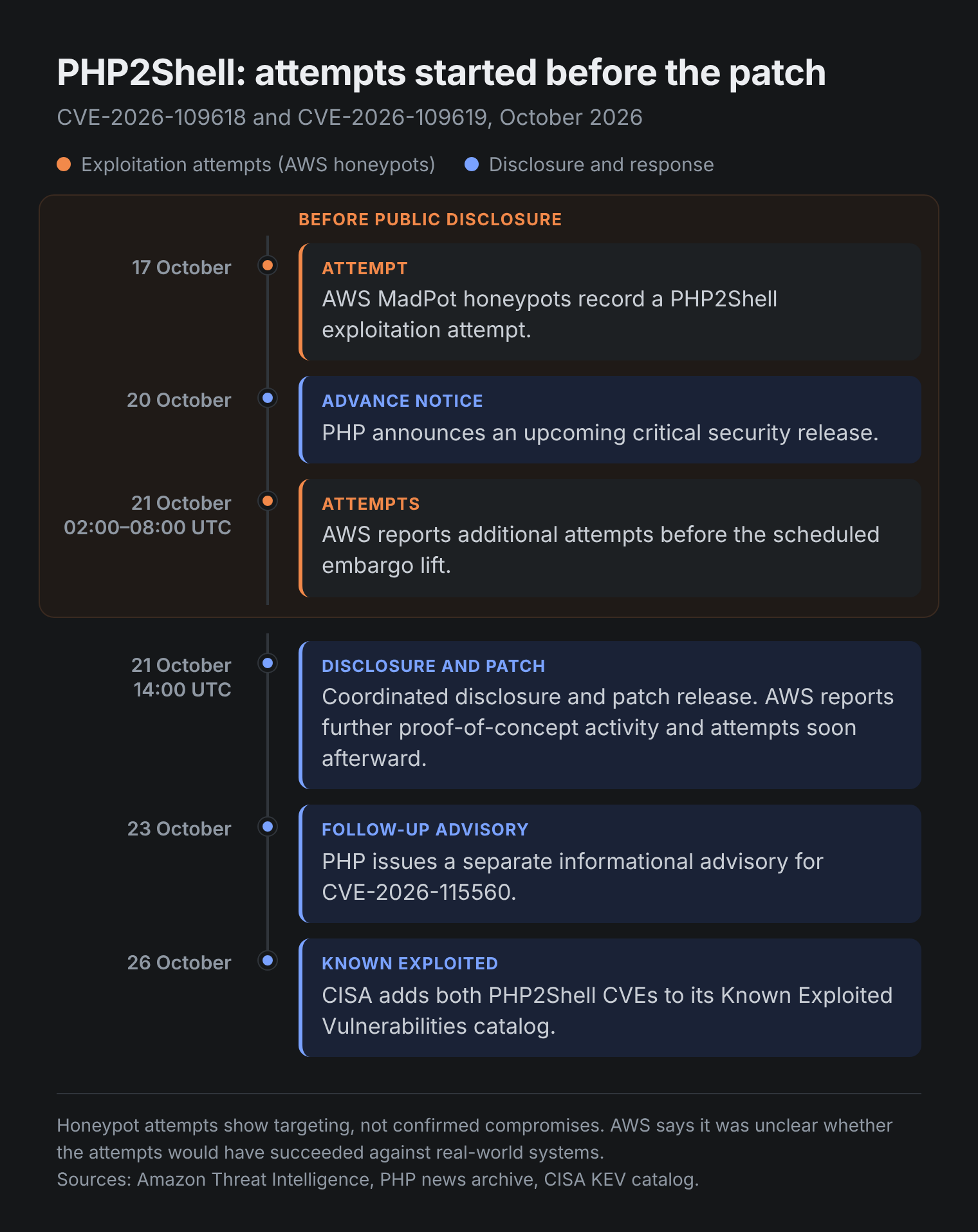
- 17 October: AWS says its MadPot honeypots recorded a PHP2Shell exploitation attempt.
- 20 October: PHP published an advance notice of the upcoming critical security release.
- 21 October, 02:00–08:00 UTC: AWS reports additional attempts before the scheduled embargo lift.
- 21 October, 14:00 UTC: the coordinated disclosure and patch release occurred; AWS reports further proof-of-concept activity and attempts soon afterward.
- 23 October: PHP issued a separate informational advisory for CVE-2026-115560.
- 26 October: CISA added both PHP2Shell CVEs to its Known Exploited Vulnerabilities catalog.
The telemetry and embargo timing come from Amazon Threat Intelligence’s report; PHP’s news archive records its advance notice and follow-up. AWS’s qualification matters: AWS says it was unclear whether the observed attempts would have succeeded against real-world systems. Honeypot attempts are evidence of targeting, not a confirmed victim count. AWS also says it does not know how the actor obtained exploit information before disclosure. This timeline does not prove AI generated those particular payloads.
For me, the uncomfortable part is the head start. Our team may begin responding when the advisory arrives. An attacker may already be working. So “we patched this morning” answers one question. “Did anything happen before this morning?” deserves its own investigation.
A separate follow-up: CVE-2026-115560
PHP’s 23 October notice identifies CVE-2026-115560: an unusual session configuration can create another potential RCE path. It requires session upload progress to remain enabled and an application to set session.serialize_handler to php_binary or php_serialize, then switch it to php at runtime with ini_set() before session_start(). PHP says applications that never change the handler at runtime can retain the feature.
At the 25 October source check, the notice recommended session.upload_progress.enabled=0 until the next regular bugfix release and said a full advisory would accompany that release. At that point, PHP had not given a complete affected-version range or identified an available fixed release for this follow-up.
For the original pair, PHP’s 21 October advisory names 8.2.35, 8.3.36, 8.4.27, and 8.5.12 as fixed releases. Vendor backports may use other package versions. Updating application code alone does not update its PHP runtime; verify the deployed package and restart affected workers. The follow-up must be tracked separately rather than described as proof that the original fixes did nothing.
This is where I would ask the question nobody enjoys: did we update the running service, or just the Dockerfile?
A merged pull request is reassuring. A forgotten worker still running the old runtime is less interested in our reassurance. “Patched” needs to describe what is actually running.
What real AI-assisted intrusions tell us
Anthropic: the September 2025 espionage campaign
Anthropic’s report, published on 13 November 2025, describes suspicious activity detected in mid-September. It assesses that a Chinese state-sponsored group used Claude Code against roughly 30 targets, succeeding in a small number of cases.
Anthropic estimates AI performed 80–90% of the campaign’s work, with humans retaining critical decisions. That is the provider’s campaign-specific estimate, not an 80–90% intrusion success rate or a measurement of all cybercrime. The report also describes hallucinated credentials and erroneous claims about stolen information.
One correction deserves preservation: Anthropic amended its wording on 14 November to “thousands of requests, often multiple per second.” It did not substantiate thousands of requests per second. The report gives valuable operational visibility, but outsiders cannot independently reconstruct every victim outcome from the public account.
AWS: the January–February 2026 FortiGate campaign
AWS’s 20 February report describes a financially motivated actor using commercial generative AI services in a campaign that compromised more than 600 FortiGate devices across over 55 countries between 11 January and 18 February 2026.
AWS says initial access relied on exposed management interfaces and weak credentials with single-factor authentication; it observed no exploitation of FortiGate vulnerabilities. Its investigation found staged tooling and operational material supporting the assessment of AI use. It also records failures against harder targets.
This case supports a narrower, more practical concern than omnipotent autonomous hacking: assistance can help an operator organize and repeat familiar techniques at scale. A count of six hundred devices does not establish six hundred independent victim organizations. The report also does not measure how many devices the actor would have compromised without AI.
These accounts establish that abuse has moved beyond hypothetical demonstrations. They do not establish how common AI-assisted intrusions are across the internet, nor a percentage increase attributable to AI. Providers observe different slices of activity, and successful investigations are not random samples.
Different incidents, different lessons
LiteLLM: an exposed key and a compromised release
LiteLLM’s 23 October canonical investigation supersedes parts of its initial account. Its sequence is instructive:
- 27 May 2026: an administrative key for an internal LiteLLM Agent Platform deployment was committed publicly. A follow-up commit deleted the file about three hours later, but the original commit stayed in public history until 22 October, and the key was never revoked.
- 10 October: an attacker used the key to access the platform and obtain an organization owner’s GitHub CLI token.
- 21 October: the attacker manipulated the release process and published malicious LiteLLM 1.107.0 artifacts.
- 23 October: the company published the corrected chain, explicitly replacing earlier assumptions.
The initial theory about tokens coming from internal deployment logs should not be repeated as the established root cause. The canonical account instead identifies an exposed administrative key and excessive GitHub authority. The artifact and response notice lists affected packages and containers; exposure depends on what was actually installed or executed, not simply whether a team uses LiteLLM.
What stays with me is the gap between “we removed that key” and “that key no longer works.” Those can feel like the same thing during a busy incident. They are not.
An agent platform holding an organization owner’s token deserves the same nervous attention as any other production control plane. The documented chain gives us plenty to fix without inventing an autonomous AI mastermind.
Nx: malicious packages targeting developer tools
The Nx S1ngularity postmortem dates malicious npm releases to 26 August 2025. A workflow injection enabled publishing-token theft; the packages ran a post-install script that searched for sensitive information, attempted to invoke local AI tools, and uploaded results through the GitHub CLI.
“Attempted to invoke” is the right level of claim. It does not prove every local agent complied or that AI was necessary for the exfiltration. The lesson I draw is about combined authority: dependencies, authenticated command-line tools, source code, and agents can coexist on one developer machine. Their access boundaries deserve to be reviewed together.
Railway and eMudhra: different failures, different responses
Railway’s 21 October disclosure describes possible access to customer environment variables, including some decrypted contents, and recommends credential rotation. The company says it believes the activity was part of a series of attacks on platform companies aimed at compromising AI inference providers. That is a stated targeting assessment; it does not demonstrate AI use by the attackers.
Google’s 20 October eMudhra disclosure describes intermediate CA private keys generated with insufficient randomness. It reports receiving the finding on 17 October and deploying Chrome blocking protections within about two hours. It does not establish AI involvement.
These incidents occurred close together. That proximity does not establish a shared actor, entry point, or cause. Keeping the explanations separate produces better responses: credential containment for one chain, trust-store and certificate remediation for another, runtime updates for PHP.
What cybersecurity benchmarks can tell us
A benchmark score can make an excellent headline. Before I let it ruin my morning, I want to read the small print.
What task did the agent get? What could it see? How many tries did it have?
Cybench contains 40 professional CTF tasks. Its leaderboard includes results on different subsets: for example, the displayed Claude Mythos Preview result is 100% on a 35-problem subset. That is not “AI can hack 100% of real organizations.” The site also notes that one task’s answer leaked in HAL’s runs of o3-mini and o1-mini, whose scores were lowered by 2.5 points. Dataset size, exclusions, and evaluation corrections belong beside the score.
CyberGym comprises 1,507 historical vulnerability instances across 188 projects. Its Level 1 leaderboard gives agents a vulnerability description and an unpatched codebase, then tests whether they can produce a working reproducer. The page explains that results are submitted by teams, runs vary, and an instance can count as solved if any allowed trial succeeds.
Reproducing a known flaw with source access is valuable. It differs from finding an unknown entry point in a hardened organization and sustaining an intrusion. Conversely, a failure on one benchmark does not prove a system is harmless in every operational setting.
Before putting two scores on the same chart, I would ask:
- Were the exact same tasks and exclusions used?
- Was the result one attempt or success across several attempts?
- What tools, hints, code, prior knowledge, and execution feedback were available?
- What were the time, token, and monetary budgets?
- Was success a crash, code execution, a patch, or an end-to-end objective?
- Was the result independently reproduced, and could the tasks have leaked?
A useful defender evaluation must go further: did the proposed patch preserve behavior, did detection generate manageable false positives, and did the team deploy safely? Comparing an offensive exploit score with a defensive marketing claim cannot establish which side is improving faster.
What CISA KEV numbers actually measure
The official CISA KEV data snapshot retrieved for this article reports 1,756 entries, catalog version 2026.10.23, released at 19:30:18.9209 UTC on 23 October 2026. That is a dated catalog total, not 1,756 vulnerabilities newly discovered this year or 1,756 intrusions.
KEV records CVE identifiers and dates added; it does not supply a field establishing that AI discovered or exploited each vulnerability. One CVE may affect many victims. Several CVEs may be used in one intrusion. Old vulnerabilities can enter the catalog much later.
Any yearly comparison should therefore count by dateAdded, preserve the snapshot, and compare equivalent periods. A partial 2026 total against all of 2025 would be a poor growth measure. Publication-to-KEV delay is also not time from discovery to first exploitation: it includes visibility and cataloging delays.
The catalog helps teams prioritize known exploitation. It cannot, by itself, answer whether AI is causing more incidents or whether attackers are outperforming defenders.
Why more reports do not prove an AI effect
Put model releases and incident disclosures on the same timeline and both may rise. That establishes a correlation at most. A disclosure date can fall months after initial access; a newly reported vulnerability may have existed for years. Better discovery and reporting can increase the visible count even while preventing harm.
A causal comparison would need similar workflows with and without AI assistance, equivalent observation periods, and stable definitions of success. It would need to count failures, human effort, cost, and the number of exposed systems. The selected vendor investigations above supply examples and mechanisms, rather than that comparison.
This matters for decisions. A rising disclosure count might justify more triage capacity. It cannot tell us how much of that budget should go to a model rather than deployment inventory, credential containment, or release controls.
So, who is moving faster?
The strongest answer the evidence supports is local: AI can give an advantage at particular stages, and the rest of the workflow determines how much that advantage matters.
PHP2Shell illustrates accelerated research alongside a disclosure and response window. The FortiGate report illustrates assistance applied to familiar weak access controls. LiteLLM illustrates how a credential can remain useful long after someone thinks its exposure has been handled. Those are three different clocks: research, exploitation, and containment.
For a defender, finding a serious bug in an hour is useful. Spending three days locating its owner and running deployment can erase much of that benefit. Conversely, a team that can identify every affected instance and deploy safely can turn the same finding into prevention. This is my interpretation of the cases, rather than a measured global ranking.
The response time your team can measure
For the next urgent advisory, record five timestamps: when the team received it, identified affected running assets, assigned an owner, deployed the fix, and verified closure. Include the final exposed instance. A good median can hide the worker everybody forgot.
For a credential incident, use the equivalent chain: discovery, scope assessment, revocation, verification that the old credential fails, and a check for sessions or jobs that remain active. Removing the secret from a file only addresses one part of the chain.
These measurements give the next tooling decision a target. If investigation dominates, assistance with code or logs may help. If ownership and deployment dominate, buying a faster investigator leaves the slow part untouched.
That is the race I would bring to a security review: if a useful weakness in our stack became known today, how long would it remain usable?
Part 2 follows the work an attacker can accelerate. Parts 3 and 4 follow a clearly labelled hypothetical engineering scenario from investigation to a verified fix and safer release controls.